How to Build the Foundations of an AI-Ready Supply Chain
Artificial Intelligence (AI) opens up major opportunities to optimise the supply chain. Yet many organisations fail because they have not built the essential foundations: fragmented data, poorly connected systems and unprepared teams. Before deploying AI models, one key question must be asked: is the supply chain truly ready?
This article outlines the six essential pillars required to turn data into decisions and build a supply chain capable of fully harnessing AI’s potential.

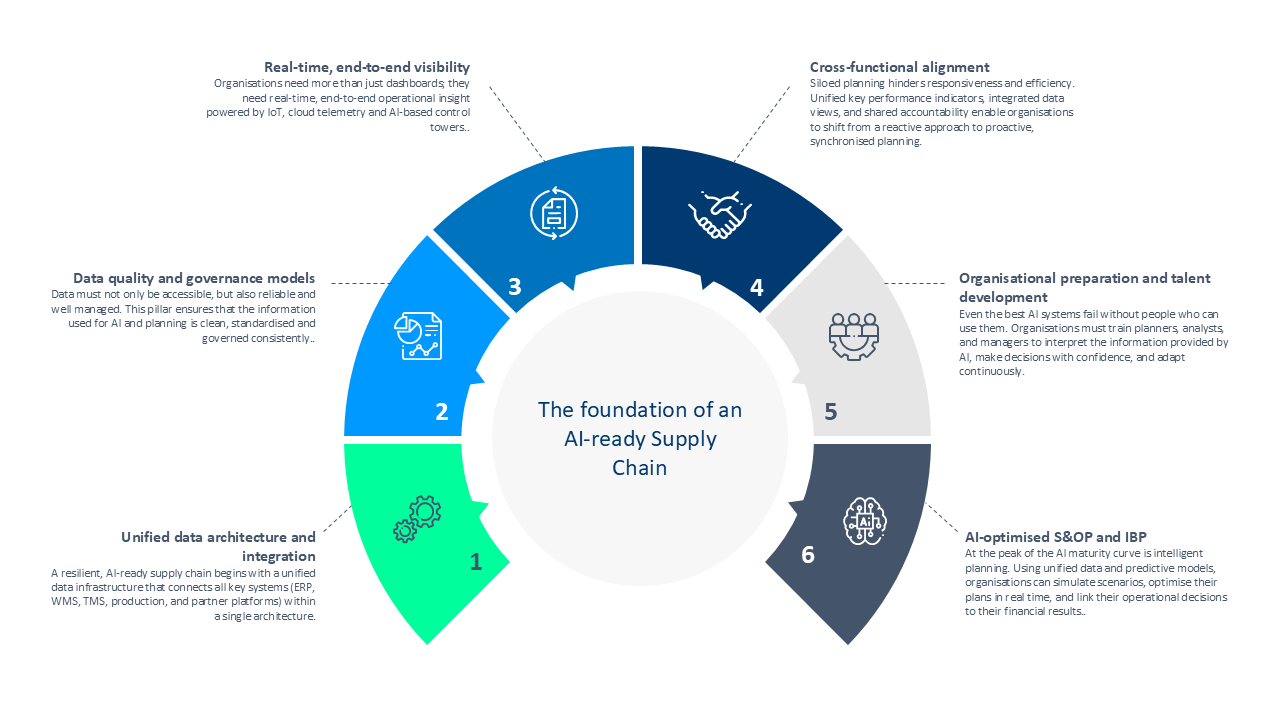
To create an AI-ready supply chain, organisations must establish a solid, integrated foundation connecting data, processes and people. This foundation rests on six key pillars, each tailored to the supply chain context and aligned with digital transformation best practice. These pillars reinforce one another to transform data into decisions.
Let us explore each pillar and how it enables the supply chain to move from concept to reality, delivering sustainable AI-driven performance :
Unified Data Architecture and Integration
In an AI-ready supply chain, data cannot remain trapped in disconnected silos. Unified data architecture and integration involve building a single, robust data infrastructure that connects all sources — from ERP and warehouse management systems to IoT sensors — within a coherent architecture.
This modern architecture (often cloud-based or designed as a “data lakehouse”) ensures seamless data flows across the organisation, providing a single source of truth. Companies relying on outdated or fragmented systems often “lose millions” in hidden inefficiencies without realising it.
A unified data architecture removes these barriers. A strong integration framework ensures that orders, inventory levels, shipments and forecasts exist within a connected ecosystem. This enables end-to-end analytics and machine learning based on complete, reliable datasets.
This first pillar transforms raw data into a strategic asset by ensuring accessibility, consistency and integration throughout the supply chain.
Data Quality and Governance
Even with a modern architecture, data only has value if it is accurate, consistent and reliable. Data quality and governance provide the discipline and oversight required to turn raw data into actionable insights.
Leading organisations do not treat governance as bureaucracy, but as a strategic enabler of AI. They implement strong data governance frameworks — with clear ownership, defined standards, quality controls and traceability — to build trust in their data.
Poor data quality can quietly undermine performance long before any AI tool is deployed. According to Gartner, 85% of AI projects fail due to poor data quality and inadequate preparation.
The solution lies in fostering a culture of data excellence. This includes rigorous data cleansing (such as deduplication, error correction and harmonisation of master data across systems) and governance processes proportionate to organisational size. High-performing companies appoint data owners and establish escalation procedures to resolve issues at source. They treat data as a product that must meet defined quality specifications.
With high-quality, well-governed data, AI models can learn effectively and supply chain teams can act confidently on their outputs.
End-to-End Real-Time Visibility
Today’s supply chains operate in a world of constant volatility where real-time responsiveness is essential. End-to-end real-time visibility means being able to monitor the entire value chain live — from suppliers and manufacturing sites to distribution centres and customer demand.
Enabled by IoT sensors, advanced telematics and cloud analytics platforms (often referred to as control towers or digital twin environments), this level of visibility fundamentally enhances agility.
Organisations with transparent, real-time data flows can anticipate disruptions and respond faster than those operating blindly. Companies with fully transparent data flows are significantly more resilient during disruptions.
For example, increased visibility enables early warnings — such as sensor readings indicating imminent equipment failure or weather events threatening supplier deliveries — allowing planners to reroute or adapt proactively.
Cross-Functional Alignment
AI readiness in the supply chain is not solely a technological challenge; it fundamentally requires breaking down organisational silos. Cross-functional alignment means harmonising objectives, processes and data across procurement, manufacturing, logistics, sales, finance and IT.
Traditionally, each function optimised its own performance, often at the expense of overall efficiency. Today’s volatility demands a different approach: the supply chain must operate as a transversal central “brain”, coordinating departments to optimise the whole.
For instance, procurement and planning teams must jointly adjust sourcing during demand spikes, while sales and operations must align on promotional activities that manufacturing can realistically support.
High-performing organisations create a collaborative culture where supply chain, operations, IT/data and commercial teams operate as one ecosystem. Meetings such as S&OP (Sales and Operations Planning) become genuine cross-functional forums with shared accountability.
This pillar ensures that when AI insights or recommendations emerge, the organisation can implement them smoothly and cohesively.
Organisational Readiness and Talent Development
No digital transformation succeeds without the right people, skills and mindset. Organisational readiness and talent development prepare the human dimension of the supply chain for the AI era.
Even the most advanced analytics will fail if users do not trust the data or lack the skills to use new tools. Conversely, data-literate, adaptable and innovation-driven teams can unlock significant value from technology investments.
This pillar begins with leadership and culture. Executive sponsorship is critical: leaders must promote a data-driven culture and lead by example. Many organisations now appoint Chief Supply Chain Officers or Chief Data Officers to drive cross-functional AI and data initiatives.
Beyond skills, change management and organisational design are equally important. Leading companies redesign processes to be more agile, shifting from hierarchical decision-making to empowered teams capable of acting quickly on AI insights.
A hallmark of AI-ready culture is psychological safety: employees are encouraged to experiment with new tools without fear of blame. Such a learning culture creates fertile ground for AI adoption.
This pillar ensures that people are as prepared as technology, building a workforce equipped with both technical expertise and adaptive confidence.
AI-Enhanced S&OP and IBP
The culmination of AI readiness lies in core planning processes. AI-enhanced Sales and Operations Planning (S&OP) and Integrated Business Planning (IBP) integrate advanced analytics into processes aligning supply, demand and financial performance.
In many industries, traditional monthly S&OP cycles have evolved into IBP — a more comprehensive, financially integrated approach. The goal is a continuous, AI-powered planning cycle that dynamically adapts to real-time changes.
AI algorithms can process vast datasets — sales trends, customer signals, supply constraints and external factors such as weather or economic indicators — to improve demand forecasting, optimise inventory and production plans, and simulate scenarios instantly.
An AI-enabled IBP platform transforms planning from a manual, periodic task into a dynamic, data-driven discipline. Machine learning models can detect demand pattern shifts faster than humans or evaluate thousands of production scenarios in seconds.
The benefits are substantial: research by Boston Consulting Group shows that AI-enabled IBP can increase annual revenue by 2–4 percentage points, reduce operating costs by 2–3 points and lower inventory levels by 15–30% on average. Planning cycles can also be shortened by 30–40%, enabling faster re-planning when conditions change.
Strengthen the Fundamentals Before Scaling AI
The message is clear: do not rush into the latest AI trend without reinforcing your fundamentals.
Organisations investing now in unified data architecture, data quality, enhanced visibility, cross-functional alignment, talent development and AI-driven planning will gain a decisive competitive advantage.
By transforming data into decisions on the basis of strong foundations, supply chain leaders empower AI to deliver on its promise. AI becomes not a passing trend, but a genuine driver of performance, agility and innovation.
And it is particularly within planning processes — still too often rigid or sequential — that this potential can be fully realised. The transition towards continuous, data-driven and AI-enabled decision cycles is the natural next step.