Modernising trading platforms: what challenges do financial institutions face in 2026?
In 2026, financial institutions face several urgent priorities: compliance, cyber security, data management, and IT cost control. Digital transformation now affects every trading organisation, regardless of its size.
Modernising trading platforms requires a clear vision and the right support at every stage. This is how VISEO supports its clients.

Regulatory compliance: a constant challenge for trading platforms
Regulators are introducing more requirements, compliance deadlines are tightening, and each new directive adds complexity to existing systems. In 2026, compliance is no longer a secondary concern; it directly affects financial institutions’ ability to operate.
Context and regulatory framework
The legal framework governing trading activities is evolving rapidly. Here are the key texts to integrate and monitor closely:
- MiFID II: pre- and post-trade transparency, best execution, and transaction reporting.
- EMIR: central clearing of OTC derivatives and reporting to trade repositories
- Basel IV: strengthened capital and risk management requirements
- DORA: digital operational resilience, penetration testing, and oversight of critical IT providers
Beyond these regulations already in force, institutions must also anticipate upcoming requirements emerging from consultations with European regulators.
At the same time, requirements relating to reporting, transparency, anti-money laundering, and personal data protection are multiplying. International institutions are especially exposed because each jurisdiction imposes its own rules and implementation timelines.
Even a temporary compliance gap can expose an institution to heavy financial penalties, reputational damage, and, in the most serious cases, the loss of its licence.
How can you make regulatory constraints a performance advantage?
Rather than simply responding to regulation, the most agile institutions integrate compliance from the design stage of their platforms. Automated compliance and reporting processes, supported by integrated solutions, can cover the entire front-to-back chain within a single environment.
|
Front-office |
Middle-office |
Back-office |
|
Trading |
Risks |
Confirmations |
|
Pricing |
P&L |
Settlements |
|
Booking |
Control |
Accounting |
This centralisation reduces gaps between systems and limits manual errors in regulatory reporting.
Adopting modular architectures also makes it easier to adapt quickly to changes in the legal framework: when a new text comes into force, the platform adjusts without requiring a complete overhaul.
Regulatory monitoring is no longer a one-off exercise but an ongoing process. Working with a partner like VISEO, with expertise in digital transformation and financial services, helps institutions anticipate regulatory change rather than reacting at the last moment.
Cyber security: protecting the platform’s assets and reputation
Compliance sets the framework, but platforms must also withstand cyber attacks. Trading environments have characteristics that make them prime targets for cyber criminals.
Overview of the digital threat landscape
These platforms combine several characteristics that increase their exposure:
- Real-time execution with an almost-zero tolerance to disruption
- Ongoing management of market, credit, and liquidity risks
- Strict order, position, and pricing strategy confidentiality
Cyber attacks targeting financial institutions are increasing, and their consequences extend far beyond IT systems.
For example, in November 2023, ICBC’s US subsidiary, the world’s largest bank by assets, suffered a ransomware attack by the LockBit group. The incident paralysed the settlement of US Treasury transactions and affected around $9 billion in assets (sources: CNBC, US Treasury).
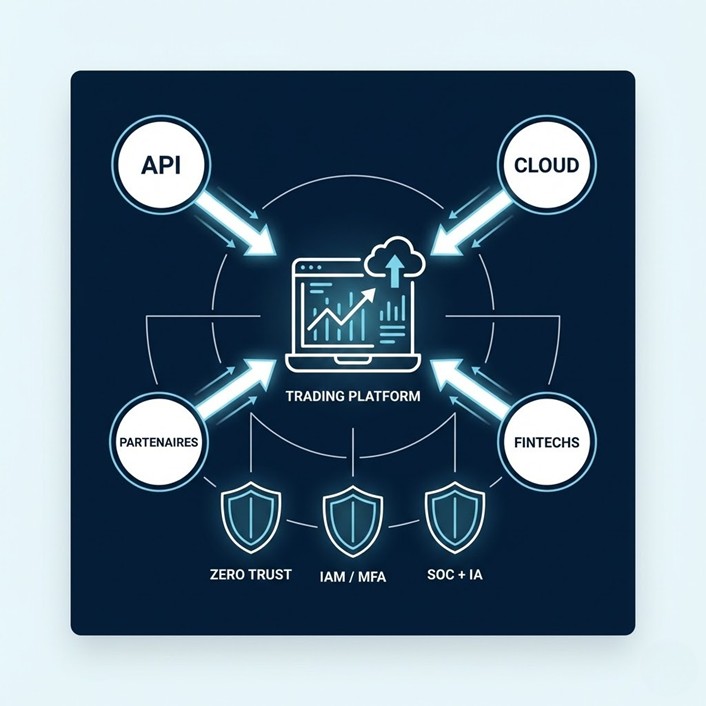
The growing number of entry points, including open APIs, cloud infrastructures, and interconnections with partners and fintechs, further increases exposure.
Strengthening trading platform security: what practical solutions are available?
The fundamentals must first be in place:
- Deployment of Zero Trust architectures, verifying every access request without exception
- Identity and access management (IAM) with SSO and MFA
- Continuous monitoring through a dedicated SOC and artificial intelligence used for threat detection
Choosing an integrated platform such as Murex offers several practical advantages. Consolidating the front-to-back chain within a single environment reduces the attack surface compared with a patchwork of heterogeneous systems. MX.3 natively integrates detailed user rights:
- Role-based access control
- Multi-factor authentication
- Data encryption at rest and in transit
- Four-eyes approval principle for sensitive operations
Murex is also SOC 1 and SOC 2 compliant, which ensures internal controls are in place. Its SaaS offering (MXSaaS) extends this commitment by managing the infrastructure, security updates, and monitoring.
Managing and extracting value from the large volumes of data generated by trading
Modern trading environments generate large data flows, and the ability to use them effectively makes the difference between reacting to the market and staying ahead of it.
The challenge posed by the volume of data generated by trading
Market, transactional, and regulatory data volumes continue to grow rapidly. The diversity of financial products is also increasing, including:
- increasingly complex derivatives
- alternative asset classes
- and structured instruments that multiply the flows that need to be processed.
In this context, real-time analysis becomes essential. Identifying counterparty risk in milliseconds or detecting an arbitrage opportunity before competitors can determine performance.
Challenges relating to storage, integration, and governance further complicate this situation. Data spread across siloed systems quickly loses value. The quality, security, and confidentiality of this data are essential to the regulatory compliance mentioned above.
Of course, artificial intelligence and machine learning offer increasing predictive analytics and strategy personalisation. However, these tools only deliver reliable results if the underlying data is clean and well structured.
How can data become a competitive advantage?
There are several practical ways to structure data management and extract measurable value:
- Implementing data lakes and scalable analytics platforms capable of absorbing growth
- Automated cleanup, structuring, and large-scale data cataloguing
- Connecting AI tools and advanced reporting systems to support decision making
VISEO supports financial institutions in designing robust, flexible, and scalable data architectures, notably through the implementation of solutions such as Murex. The MX.3 platform provides tangible advantages:
- Centralisation of all front-to-back data in a single repository
- Built-in control of data quality and consistency at every stage of the lifecycle
- Proven scalability in the most active markets, including volumes of several million transactions per day
- Real-time availability of risk, P&L, and position data
Reducing IT costs linked to platform maintenance and integration
Reliable data and strong security only matter if the underlying infrastructure is economically sustainable. In many financial institutions, maintenance and integration costs absorb a disproportionate share of the IT budget, to the detriment of higher-value investments.
Understanding the challenge of reducing IT costs
Legacy platforms, often built in successive layers over many years, generate high maintenance costs.
Every update, patch, and regulatory adjustment draws heavily on resources in systems that are sometimes ageing and poorly documented. Interoperability between these different systems adds complexity:
- Application silos increase
- Data does not flow easily from one system to another
- Each new connection requires dedicated development
This rigidity also limits the institution’s ability to launch new products or adapt to market developments. Time to market, now a key competitive factor, is slowed when each initiative must work through temporary integration layers.
The challenges of scalability and agility arise in the same way: scaling up an infrastructure made up of disparate components is expensive and time-consuming, while transaction volumes and regulatory requirements continue to grow.
What strategies can optimise maintenance and integration?
There are two main ways to reduce these costs.
The first is to adopt modular platforms based on open standards. This type of architecture reduces integration costs, simplifies updates, and facilitates module replacement without rendering the whole system obsolete.
The second is to migrate to cloud or hybrid architectures, which share infrastructure resources and reduce costs for hosting, backups, and monitoring.
Murex fits this approach. Its MX.3 platform, designed in a modular way, reduces TCO (Total Cost of Ownership) when integrated into a cloud architecture. Consolidating the front-to-back chain within a single environment eliminates the need to develop bespoke connectors between separate systems.
VISEO supports clients throughout this transition, from auditing existing systems to deployment, balancing cost control with improved performance.
Attracting and retaining talent for specialist technologies
Optimising infrastructure and reducing costs is only the first step. However, these efforts lose their impact if the institution lacks the internal skills to manage the platform day to day.
The challenge of attracting and retaining experts
Murex expertise is one of the most sought-after skill sets in the financial technology market.
Qualified specialists are limited, highly sought after, and difficult to retain. This scarcity creates real pressure when launching a modernisation project: the risk of not finding the right resources, or of losing them along the way, affects delivery timelines and implementation quality.
How can a modernisation project be made attractive to talent?
Rather than carrying this risk alone, working with a partner such as VISEO helps secure the success of the project.
This knowledge transfer approach limits dependency, reduces recruitment costs, and provides institutions with a solid foundation for long-term development. This approach reduces dependency, lowers recruitment costs, and ensures institutions have a solid foundation for sustainable growth.