Modern ERP Cloud System
March 3, 2025
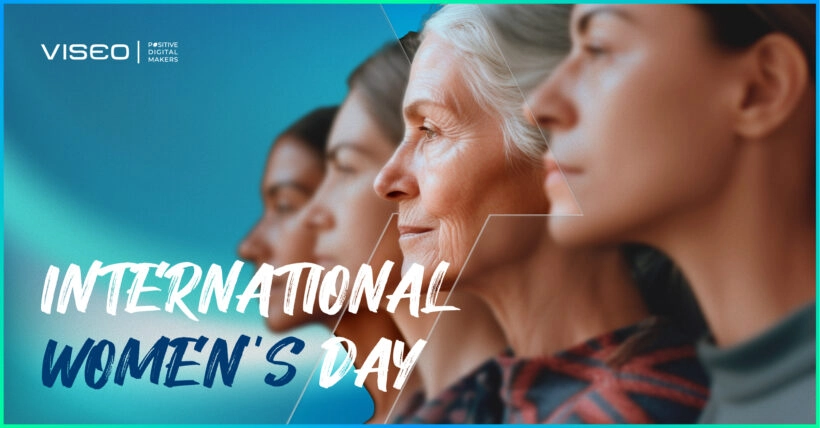
On an international scale, VISEO’s teams are committed to gender parity. In 2025, women will represent 35% of the workforce (an increase of 2% in three years) and will increasingly occupy management positions (+4.5% between 2023 and 2025). How can we continue to move forward together in this direction? We interviewed Amélie Viéville, Dipanti Das and Genowine Bancale, who hold key positions in the Talent Acquisition team in France, Morocco and Asia and Oceania. We asked the following questions. What is the proportion of women in tech and digital? What changes are they seeing and how can we move towards greater professional equality? We provide an overview of current trends in the world of digital services companies in this first part of the series of interviews.
Amélie: Yes, it’s still true, but I’m seeing a real desire to change the perspective. Large companies are implementing policies on gender parity, feminisation and inclusion, such as Salesforce with its ‘1,000 Women in Tech’ recruitment programme. There are growing numbers of initiatives, including: communication, mentoring for young women and training. Progress is slow, but women will climb the ladder in the years to come.
Genowine: Across the world, digital services companies have indeed made great strides towards gender equality. More and more women are occupying management positions. In the Asia division, I receive many applications from women for technical positions as developers, programme managers or architects, which was less common a few years ago.
Dipanti: Women’s professional communities and networks such as SheTech and Women in Tech are also bringing a new dynamic. From these networks women find mutual support, encouragement and advice. They lift each other up.
Dipanti: I’ve always been interested in technology, ever since my studies, even though I am far from having coding skills for which I am recruiting. It’s a sector that pushes you to stay on your toes. Everything changes very quickly.
Genowine: While I’m fascinated by technology, I also wanted interaction in my professional life. Digital services companies offer great opportunities for all kinds of collaboration, whether with clients, managers, colleagues or candidates. I also like to understand other people’s needs and offer them tailored solutions.
Amélie: I came into tech by chance. However, I quickly felt very comfortable there. Previously, I worked in a traditional recruitment agency, sometimes in IT, but mainly in the agri-food sector. In digital services companies, the positions are varied, change very quickly and there are many opportunities for advancement. New jobs are constantly being created, as is the case today with AI. It’s a chance to support our clients through major technological revolutions.
Digital services companies offer great opportunities for all kinds of collaboration, whether with clients, managers, colleagues or candidates.

Genowine Bancale
Talent Acquisition Manager COE, VISEO
Dipanti: VISEO is present in 13 countries in Asia. There are, of course, differences from one culture to another, but in general, more and more women are pursuing higher education. It often depends on their approach to family organisation. Are they willing to travel, especially abroad? Are they willing to make their career their priority and break with tradition by exploring new professional fields? In China and the Philippines, women are entering all sectors, including those that were previously reserved for men.
Amélie: In my field, I also see differences in profiles depending on the country. In Morocco, 50% of our employees are women. They are hired first and foremost for their technical skills. We are just looking for good applicants. We often spot them while they are still studying at engineering schools. In the students’ eyes, these schools represent the fast track to excellence. In France, in technical professions, the gender gap remains more significant. There are still social and educational biases that keep women out of these fields from an early age, limiting their access and representation in these careers. It is a collective issue. To move towards better representation of women in our professions, it is essential to work together on educational, cultural and professional levers.
Genowine: Especially at the beginning of your career, it’s important not to be discouraged or pigeonholed by certain clichés. Demonstrating your skills, building your credibility and letting your work speak for itself is an excellent way to prove yourself and build your confidence over the years.
To move towards better representation of women in our professions, it is essential to work together on educational, cultural and professional levers.

Amélie Viéville
Talent Acquisition Director France, VISEO
Amélie: In my opinion, there are no skill barriers. Beyond a system that does not encourage women to explore fields considered masculine, there are also psychological barriers that hold women back, including the idea that we are not “up to the task”. It’s essential to tell yourself that you have exactly the same opportunities as a man. It’s curiosity, the desire to succeed and the willingness to learn that will make the difference.
Genowine: In addition to knowing how to showcase your skills, surrounding yourself with the right people and, as Dipanti mentioned, being part of an empowerment network seems very important to me. Focusing on continuing education, learning about different technologies and practising regularly will all help you feel ready to take on management roles.
Dipanti: I would say two things. First, build your confidence. It shows in your body language and the way you speak, whether in interviews, with managers or with clients. Support networks are also a great help. Today, between LinkedIn and other platforms, it’s very easy to develop connections. Connect with people who are like you or who inspire you. Don’t be shy, be fearless!
Build your confidence. It shows in your body language and the way you speak, whether in interviews, with managers or with clients.

Dipanti Das
Talent Acquisition Director Asia & Oceania, VISEO
Modern ERP Cloud System
March 3, 2025
June 2, 2025